


RS53360 - High-Current Buck Converter for AI, Servers, and Networking

Features
Wide Input Range & High-Current Output
• The RS53660 supports a 2.97V to 16V input range with external bias
• 4.5V to 16V input with internal bias
• 0.6V to 5.5V output voltage
• 20A continuous output current
High-Performance Regulation & Control
• Adaptive Constant-On-Time control for fast transient
response
• ±0.5% output voltage accuracy
• Differential remote sensing
• Programmable switching frequency from 400kHz to 2MHz
• Programmable DCM / CCM operation
• Programmable soft-start
PMBus, Configuration & Telemetry
• PMBus 1.5 interface
• Nonvolatile memory (NVM) configuration
• Integrated telemetry
Comprehensive Protection
• OCP, UVP, UVLO, and OTP
Package
• 4mm × 5mm, 33-pin LGA package
• RoHS compliant and Green
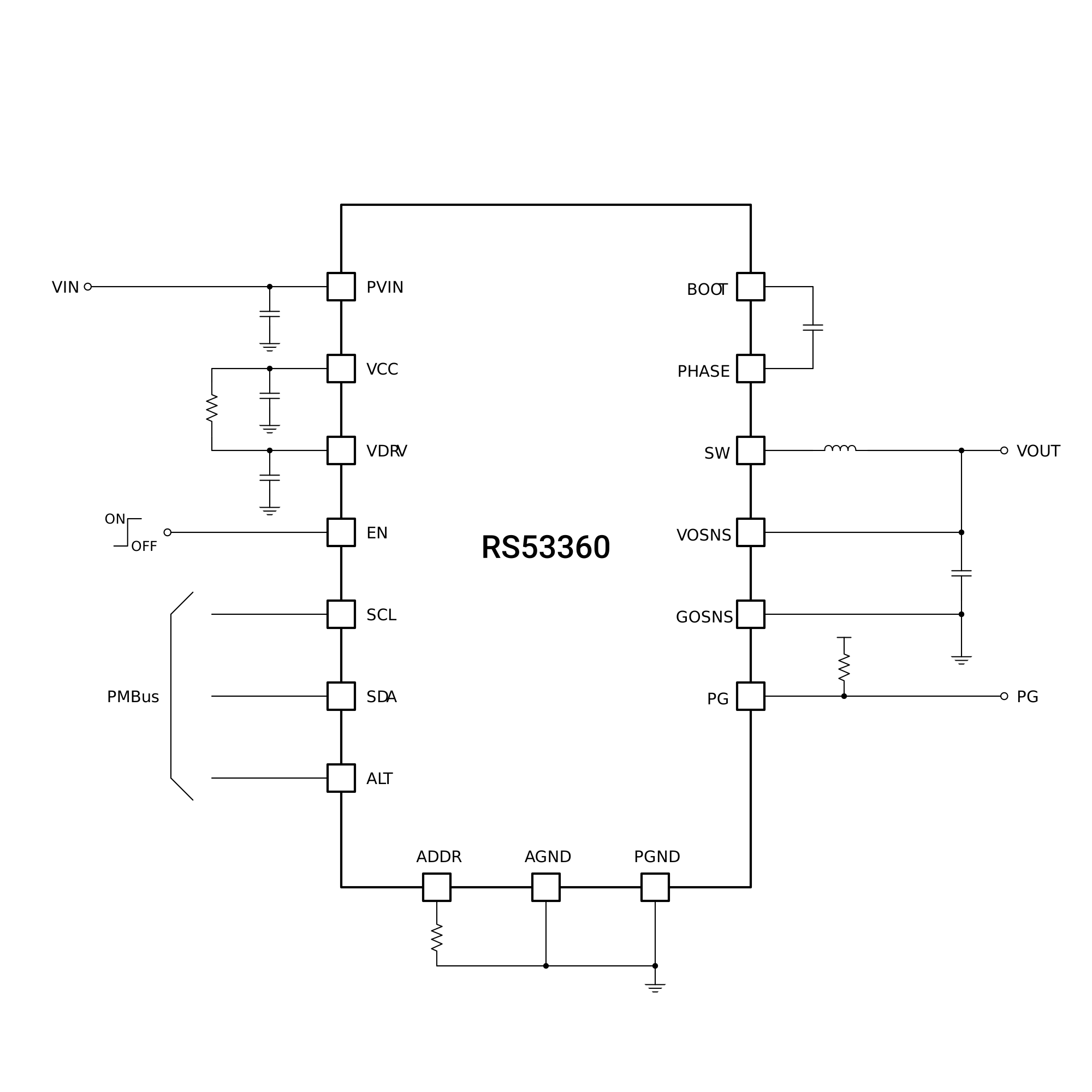
Description
RS53360 20A Synchronous Buck Converter with PMBus
The Reed Semiconductor RS53360 is a high-performance, 20A synchronous buck converter with PMBus 1.5, designed for high-current point-of-load (PoL) power applications. Combining Adaptive Constant-On-Time (COT) control, differential remote sensing, integrated telemetry, and programmable power management, the RS53360 provides precise voltage regulation for servers, AI computing systems, FPGA and ASIC power rails, networking equipment, and storage applications.
The RS53360 supports a 2.97V to 16V input range with an external bias supply or 4.5V to 16V operation using its internal bias supply. An adjustable 0.6V to 5.5V output range, 20A continuous output capability, and compact 4mm × 5mm, 33-pin LGA package make it suitable for high-density power architectures requiring flexible configuration and accurate regulation.
High-Current 20A Point-of-Load Power Conversion
The RS53360 delivers up to 20A of continuous output current, providing a compact power conversion solution for high-current digital loads. Its wide input-voltage range supports multiple system power architectures, while the adjustable output enables designers to accommodate different processor, memory, FPGA, and ASIC supply requirements.
The converter supports operation from a 2.97V to 16V input when an external bias supply is available, or from 4.5V to 16V using its internal bias circuitry. This flexibility allows the RS53360 to be integrated into a variety of distributed power systems.
With an output-voltage range of 0.6V to 5.5V, the device supports low-voltage digital power rails and auxiliary supplies requiring precise voltage regulation.
Adaptive Constant-On-Time Control and Precision Regulation
The RS53360 employs Adaptive Constant-On-Time (COT) control to provide fast transient response during rapid changes in output load current. This control architecture is particularly valuable in FPGA, ASIC, and processor power applications where dynamic current demands can cause significant load transients.
Differential remote sensing compensates for voltage drops between the converter and the load, improving regulation accuracy at the point of use. Combined with ±0.5% output-voltage accuracy, this capability supports power rails with tight voltage-tolerance requirements.
The switching frequency is programmable from 400kHz to 2MHz, allowing designers to balance switching losses, external component size, and power supply performance.
Selectable Discontinuous Conduction Mode (DCM) and Continuous Conduction Mode (CCM) operation provides additional flexibility for optimizing converter behavior across different load conditions.
PMBus 1.5 Digital Configuration and Integrated Telemetry
The RS53360 incorporates a PMBus 1.5 interface for digital power management, configuration, and telemetry.
Through PMBus communication, system controllers can access supported device settings and monitoring functions, simplifying integration into digitally managed power architectures.
Integrated telemetry provides visibility into converter operation, supporting system-level monitoring and power management. This capability is particularly useful in servers, AI computing platforms, networking infrastructure, and other systems where power supply status is an important part of overall system management.
The device also includes nonvolatile memory (NVM) for storing programmable configuration settings. This allows selected device parameters to be retained without requiring the system controller to reconfigure every setting after power cycling.
Programmable Switching Frequency and Soft-Start
The RS53360 supports a programmable switching-frequency range of 400kHz to 2MHz, giving designers flexibility when optimizing efficiency, transient response, and external component selection.
Lower switching frequencies can help reduce switching-related losses, while higher frequencies can support smaller external inductors and capacitors. The appropriate operating frequency depends on the system’s efficiency, thermal, transient-response, and PCB-area requirements.
Programmable soft-start provides control over the output-voltage startup ramp, helping manage capacitor-charging current and reduce disturbances on the upstream power supply.
Together with selectable DCM/CCM operation, these features allow the RS53360 to be configured for different power-system requirements.
Comprehensive Protection and Power Management
The RS53360 integrates multiple protection functions to support reliable power conversion under abnormal operating conditions.
Built-in overcurrent protection (OCP) helps protect the power stage against excessive current demand, while undervoltage protection (UVP) monitors output-voltage conditions. Undervoltage lockout (UVLO) prevents operation when the applicable supply voltage is insufficient, and overtemperature protection (OTP) responds to excessive device temperature.
These protection functions complement the converter’s PMBus configuration and telemetry capabilities, providing a foundation for system-level power monitoring and fault management.
Compact 33-Pin LGA Package for High-Density Power Systems
The RS53360 is available in a compact 4mm × 5mm, 33-pin LGA package, occupying just 20mm² of PCB area for the converter IC.
Its combination of high-current capability, differential remote sensing, programmable control, and digital power management makes it well suited for space-constrained point-of-load applications.
Typical applications include:
- Server and AI Computing Power: High-current digital power rails in computing platforms
- FPGA, ASIC, and Processor Power: Precision low-voltage power conversion for programmable and custom logic
- Networking and Telecom Equipment: Distributed point-of-load power architectures
- Storage Systems: Regulated power for storage controllers and associated circuitry
- Graphics Cards and Gaming Systems: High-current auxiliary and digital power rails
- High-Current PoL Power Supplies: Compact digitally managed DC-DC conversion
The RS53360 combines 20A synchronous buck conversion with PMBus 1.5 programmability, precision regulation, and integrated protection in a compact package, providing a flexible solution for modern high-current power systems.
Explore Reed Semiconductor’s complete portfolio of Point-of-Load (PoL) DC-DC Converters for additional high-performance power conversion solutions.

