


RS53329 - 16V, 20A Precision Regulation Buck Converter

Features
High-Performance Power Conversion
- The RS53329 is a Robust Constant-On-Time (RCOT) control for fast transient response
- Up to 20A continuous output current
- Wide input voltage range:
- 2.85V to 16V with external bias
- 4V to 16V with internal bias
- Output voltage range:
- 0.6V to 5.5V (RS53329L)
- 0.9V to 5.5V (RS53329H)
- 90% maximum duty cycle
- The RS53329 has excellent line and load regulation
- ±0.5% output voltage accuracy
- Differential remote sensing
Flexible System Optimization
- The RS53329 supports the following switching frequencies:
- 600kHz
- 800kHz
- 1MHz
- 2.1MHz
- Programmable switch valley current limit
- Programmable soft-start time
- Selectable Pulse Skip Mode or Continuous Conduction Mode (CCM) operation at light load
- Ultra-low 1.0µA shutdown current into the VIN pin
Integrated Protection & Monitoring
- Non-latch Overcurrent protection (OCP)
- Undervoltage protection (UVP)
- Undervoltage lockout (UVLO)
- Overtemperature protection (OTP)
- Latch-off Overvoltage protection (OVP)
Compact Integration
- The RS53329 is a fully integrated synchronous buck converter
- Compact 3mm × 4mm, 21-pin QFN package
- RoHS compliant and Green
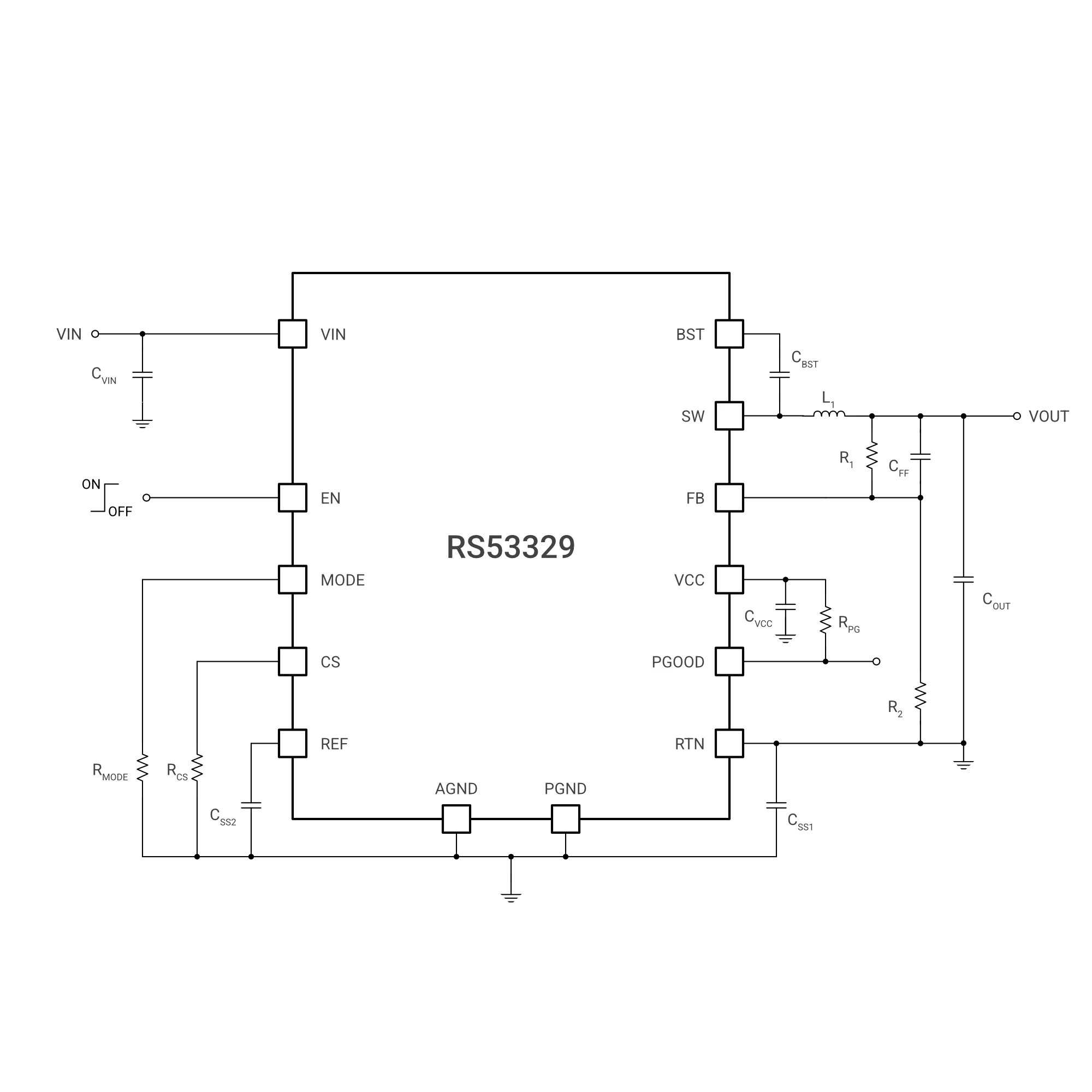
Description
High-Current 20A Buck Converter for AI, Server, and Networking Applications
The RS53329 is a fully integrated 20A synchronous buck converter designed for high-current Point-of-Load (POL) applications requiring exceptional transient response, high efficiency, and flexible system optimization. Featuring Robust Constant-On-Time (RCOT) control, the converter delivers stable output voltage during rapidly changing load conditions, making it ideal for powering modern digital processors and high-performance computing platforms.
Supporting input voltages from 2.85V to 16V with an external bias supply or 4V to 16V using the integrated internal bias, the device provides outstanding design flexibility for 12V intermediate bus architectures. Differential remote sensing, programmable switching frequency, programmable soft-start, and programmable current limit allow designers to optimize efficiency, thermal performance, and board layout for demanding applications.
Packaged in a compact 3mm × 4mm, 21-pin QFN, it integrates power MOSFETs, comprehensive protection, and system monitoring features into a compact, high-power-density solution.
Optimized for High-Current Digital Power
Today’s AI accelerators, processors, networking equipment, and storage systems require power converters capable of delivering large amounts of current while maintaining tight voltage regulation during rapid load transients. RCOT control enables the converter to respond quickly to changing current demands while maintaining excellent line and load regulation.
Fast Transient Response
The RS53329 Robust Constant-On-Time (RCOT) control rapidly adjusts to changing load conditions, minimizing output voltage deviation for processors, ASICs, FPGAs, GPUs, and other dynamic digital loads.
High Output Current
Delivering up to 20A of continuous output current, the converter supports demanding Point-of-Load applications without requiring external power stages, simplifying system design while reducing PCB area.
Flexible System Optimization
Multiple programmable features allow designers to optimize the RS53329 performance for efficiency, thermal management, EMI, and startup behavior.
Wide Input Voltage Range
The converter supports:
- 2.85V to 16V with an external bias supply
- 4V to 16V using the integrated internal bias
This flexibility makes it suitable for standard 12V power distribution architectures found in servers, networking equipment, storage systems, and industrial platforms.
Programmable Switching Frequency
Selectable switching frequencies of 600kHz, 800kHz, 1MHz, and 2.1MHz allow designers to balance efficiency, transient response, solution size, and EMI performance.
Programmable Current Limit and Soft-Start
Programmable switch valley current limit and adjustable soft-start provide greater control over startup behavior and overload protection, simplifying optimization for a wide range of system requirements.
Selectable Light-Load Operation
Designers can select Pulse Skip Mode for improved light-load efficiency or Continuous Conduction Mode (CCM) where constant switching frequency is preferred.
Precision Regulation and Integrated System Functions
Integrated monitoring and precision regulation features improve overall system performance while reducing external component count.
Differential Remote Sensing
Differential remote sensing compensates for PCB trace voltage drops, helping maintain accurate output voltage at the load. This feature is particularly valuable in high-current applications where voltage drops can significantly impact regulation accuracy.
Excellent Output Accuracy
A precision internal reference and differential sensing architecture provide excellent line and load regulation with ±0.5% output voltage accuracy, helping ensure reliable operation across varying operating conditions.
Integrated System Features
Additional integrated functions include:
- Power Good (PGOOD) output
- Ultra-low 1.0µA shutdown current into the VIN pin
- Stable operation with low-ESR ceramic output capacitors
These integrated features simplify implementation while improving system reliability and efficiency.
Comprehensive Protection for Reliable Operation
Multiple protection mechanisms safeguard both the converter and downstream circuitry during fault conditions.
Built-In Protection Features
Integrated protection includes:
- Non-latch Overcurrent Protection (OCP)
- Undervoltage Protection (UVP)
- Undervoltage Lockout (UVLO)
- Overtemperature Protection (OTP)
- Latch-off Overvoltage Protection (OVP)
These protection features improve system robustness while minimizing the need for external supervisory components.
Compact Integration for High-Density Designs
Integrated power MOSFETs, advanced control circuitry, and a compact 3mm × 4mm QFN package enable high-current power conversion in space-constrained applications.
The combination of high output current, programmable operation, and minimal external components allows designers to reduce solution size while maintaining outstanding electrical performance.
Typical Applications
AI and High-Performance Computing
Power AI accelerators, GPUs, CPUs, ASICs, and FPGA platforms requiring high-current, tightly regulated Point-of-Load power.
Servers and Storage
Provide efficient power conversion for enterprise servers, storage systems, SSD controllers, and data center infrastructure.
Networking and Telecommunications
Support routers, switches, optical networking equipment, base stations, and communication infrastructure with excellent transient response and precision regulation.
Consumer and Industrial Electronics
Deliver high-current power for gaming systems, graphics cards, televisions, embedded computing, and industrial automation equipment.
Explore Reed’s Point-of-Load Power Solutions
The RS53329 is part of Reed Semiconductor’s expanding portfolio of Point-of-Load power solutions for AI, computing, networking, telecommunications, and industrial applications. Reed’s portfolio also includes compact synchronous buck converters, PMBus™ digital regulators, multiphase controllers, Smart Power Stages, and Power Blocks, enabling designers to build scalable, high-efficiency power architectures from the intermediate bus to the processor core.
Applications
- Telecom/Datacom
- Base Station
- Computing, Servers, Storage, AI
- Point of Load (POL) Module
- Standard 12V Rail Supplies
- Gaming Consoles and Graphic Cards
- TV Power
Ordering Information
| Part Number | Notes | Status | RoHS | Package | Buy / Sample |
| RS53329HR | Vref = 0.9V | Active | Yes | 3 x 4mm, QFN-21 | |
| RS53329LR | Vref = 0.6V | Active | Yes | 3 x 4mm, QFN-21 | B |

