


RS17G22 - PWMVID, AVS & PMBus

Features
High-Performance Multiphase Control
- The RS17G22 is a Dual-railPWMVID/AVSBus controller supporting up to 16 total phases (16+0 to 8+8)
- Native Trans-Inductor Voltage Regulator (TLVR) support
- No external passive components required
- Flexible phase assignment and ordering
- Up to 4MHz switching frequency
- Constant On-Time (COT) control for fast transient response
Optimized for AI, Server & Telecom Power
- Compatible with Reed Semiconductor Smart Power Stages and Power Modules
- Integrated 1kΩ current-sense resistor
- Automatic phase add/drop for improved light-load efficiency
- Thermal balance management
Precision Regulation & Telemetry
- 4.5V to 16V input voltage range
- 0.2V to 2.8V output voltage range
- ±0.5% output voltage accuracy with differential sensing
- ±1.5% input/output voltage telemetry accuracy
- ±1.5% output current telemetry accuracy
- ±2°C temperature telemetry accuracy
Advanced Control & Optimization
- Programmable DC load-line
- Programmable overshoot and undershoot reduction
- Programmable slew-rate control
- Internal compensation
- Field-programmable Multiple-Time Programmability (MTP)
- Up to 32 rewrites
- Black-box fault logging
Protection & Reliability
- Programmable fault response
- Latch-off or auto-retry
- UVLO, UVP, OVP, OCP, and OTP protection
- Cycle-by-cycle per-phase current limiting
Industry-Standard Interfaces
- NVIDIA PWMVID compliant
- PMBus™ v1.4.1 compliant
- AVSBus compliant
Compact Solution
- Reduces output capacitance and external passive components
- Smaller PCB area and lower BOM cost
- 7mm × 7mm, 56-pin QFN package
- RoHS compliant
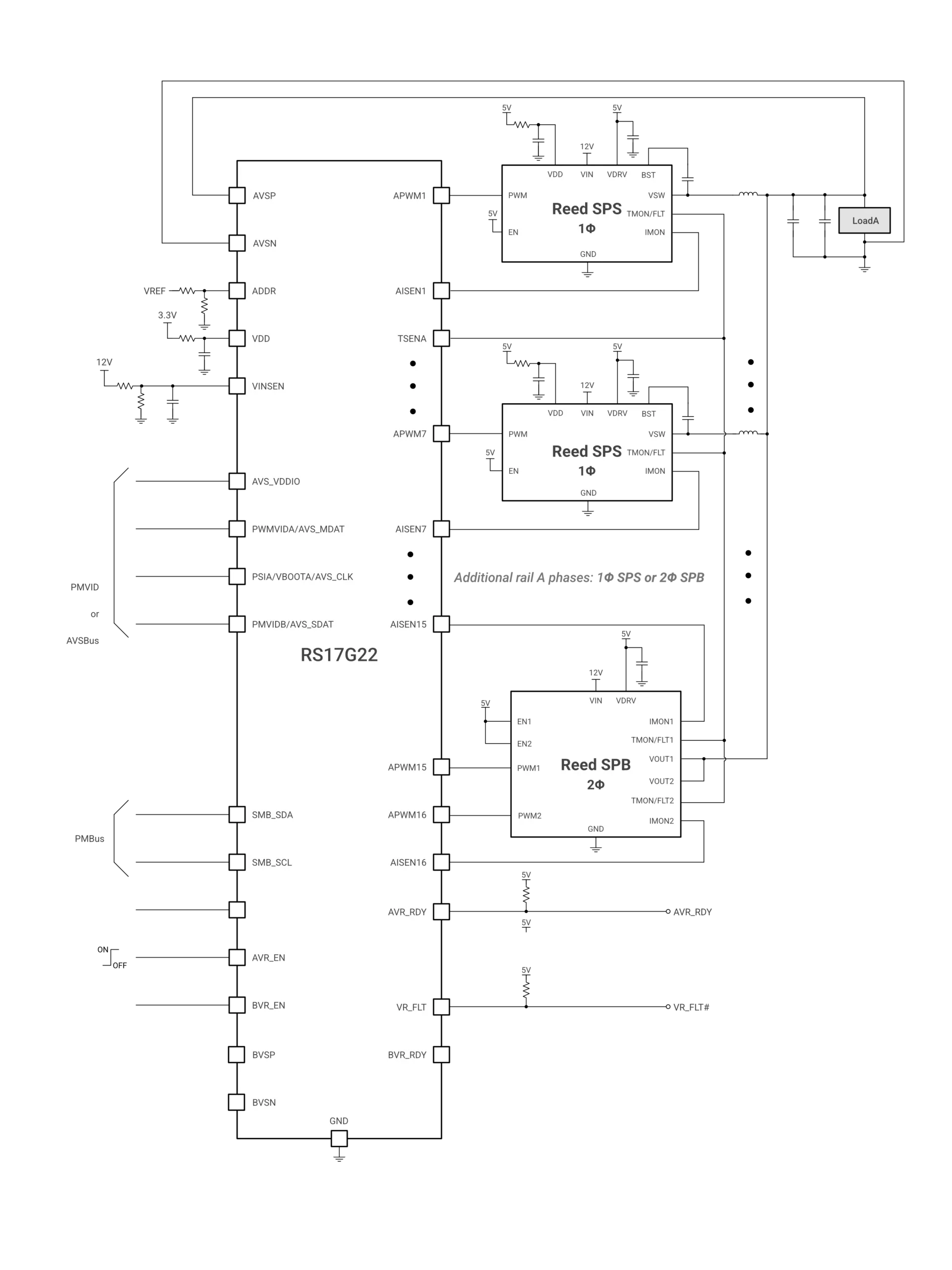
Description
High-Performance 16-Phase Digital Multiphase Controller
The RS17G22 is a dual-rail digital multiphase buck controller supporting up to 16 total phases (16+0 to 8+8) for AI accelerators, high-performance servers, networking equipment, telecom infrastructure, and high-current FPGA power rails. Native Trans-Inductor Voltage Regulator (TLVR) support, PMBus™, AVSBus, and NVIDIA PWMVID compatibility enable exceptional transient response, high efficiency, and comprehensive telemetry for today’s most demanding processor power architectures.
Designed to operate seamlessly with Reed Semiconductor Smart Power Stages, Smart Power Blocks, and Integrated Power Modules, the RS17G22 enables complete high-density voltage regulator solutions with reduced PCB area, lower BOM cost, simplified layout, and improved thermal performance.
Native TLVR Architecture
TLVR Without Additional Passive Components
The RS17G22 includes native support for Trans-Inductor Voltage Regulator (TLVR) architectures without requiring external passive components. TLVR significantly improves load transient performance while reducing the amount of bulk output capacitance needed around modern CPUs, GPUs, and AI accelerators.
Faster Dynamic Response
Combined with Constant-On-Time (COT) control, programmable slew rates, and advanced digital compensation, the controller delivers fast voltage regulation during large load current transients while minimizing output voltage overshoot and undershoot.
Flexible Multiphase Architecture
Up to 16 Total Phases
The RS17G22 supports flexible dual-railphase configurations from 16+0 through 8+8, allowing designers to optimize the power architecture for single-rail or dual-rail processor applications.
Automatic Phase Management
Programmable automatic phase add/drop improves light-load efficiency while maintaining excellent transient performance across the full operating range.
Flexible Phase Assignment
Flexible phase ordering simplifies PCB routing and enables optimized layouts for complex high-current power stages.
Optimized for Reed Semiconductor Power Solutions
Smart Power Stages
The RS17G22 is fully compatible with Reed Semiconductor Smart Power Stages, providing a complete digital voltage regulator solution optimized for AI and server processors. When combined with Reed Smart Power Stages, designers benefit from higher efficiency, excellent thermal performance, and industry-leading power density.
Smart Power Blocks
Pairing the RS17G22 with Reed Smart Power Blocks creates compact, highly integrated multiphase power solutions with reduced design complexity, optimized switching performance, and simplified PCB layout.
Precision Digital Control and Telemetry
PMBus and AVSBus Interface
The integrated PMBus™ v1.4.1 and AVSBus interfaces provide complete digital configuration, monitoring, and system management without requiring additional supervisory devices.
Accurate Telemetry
High-accuracy telemetry simplifies system diagnostics by providing:
- ±1.5% input voltage accuracy
- ±1.5% output voltage accuracy
- ±1.5% output current accuracy
- ±2°C temperature accuracy
Multiple-Time Programmability
Built-in Multiple-Time Programmability (MTP) supports up to 32 rewrites, allowing production calibration, firmware optimization, and future feature updates without replacing the device.
Advanced Voltage Regulation
Programmable Load-Line Control
Programmable DC load-line compensation allows designers to optimize processor voltage regulation while minimizing output capacitance requirements.
Optimized Transient Performance
Programmable overshoot and undershoot reduction thresholds improve transient response for rapidly changing processor loads common in AI, cloud computing, and networking applications.
Internal Compensation
Integrated compensation reduces external component count while simplifying loop stability optimization across a wide operating range.
Comprehensive Protection Features
The RS17G22 integrates a complete suite of programmable protection features to improve system reliability.
Protection Functions
- Input undervoltage lockout (UVLO)
- Output undervoltage protection (UVP)
- Output overvoltage protection (OVP)
- Overcurrent protection (OCP)
- Overtemperature protection (OTP)
- Cycle-by-cycle per-phase current limiting
- Programmable latch-off or auto-retry fault response
Integrated fault logging further simplifies system debugging and post-fault analysis.
High Efficiency and Reduced System Cost
The RS17G22 helps reduce overall system cost by combining advanced digital control with intelligent power management features.
Benefits include:
- Reduced output capacitance through TLVR support
- Fewer external passive components
- Smaller PCB footprint
- Improved light-load efficiency
- Reduced thermal stress
- Optimized BOM cost
These advantages make the controller well suited for next-generation AI servers, cloud computing platforms, networking switches, telecom infrastructure, and accelerator cards.

